

Many parents often ask the same question: What is the right age to buy my child a mobile phone or smartphone?
The answer is, there is no single age that is appropriate for every child. The decision depends not only on age, but also on the child’s maturity, independence, ability to follow rules, their relationship with technology, and understanding of online risks.
There are also practical concerns. Should we buy an expensive smartphone or a less expensive device, given the possibility that it may be lost or damaged? Is the child responsible enough to avoid unauthorized purchases, in-app purchases, games and other services that could result in unexpected costs?
Another important consideration is safety. We may want our child to have a phone so they can communicate with us, know where they are, and allow them to call for help if necessary.
Peer pressure can also influence the decision. Children may say, “Everyone else has a phone. Why don’t I?” Naturally, we want our children to feel included and not unfairly excluded from their peers.
However, the decision should not be based simply on what other children are doing. Giving a child a smartphone also gives them access to social media, games, messaging, online communities, advertising and potentially inappropriate content.
The important question is therefore not “how old is my child?” but “Is my child ready for the responsibility that comes with having a smartphone?”
Age Appropriateness & Psychological Perspective
From a psychological and developmental perspective, using a smartphone responsibly requires several skills, including self-regulation, impulse control, judgment, responsibility and the ability to understand consequences.
These abilities develop gradually throughout childhood and adolescence and each child is unique. Children of the same age can therefore differ considerably in their readiness.
For this reason, it is better to avoid treating a particular age as a universal threshold for smartphone ownership.
A child may be mature enough to use a basic phone for communication but not yet ready for unrestricted access to social media, online games, app stores or the wider internet.
The earlier a child receives unrestricted access to a smartphone, the earlier they are being asked to manage a complex set of responsibilities. We should therefore consider whether our child has demonstrated the necessary skills in other areas of life.
A smartphone may become particularly useful when a child begins to have greater independence. For example, a smartphone can be useful when a child starts travelling to school independently, when they are attending activities without a parent, or spending more time away from trusted adults.
If a child is always accompanied by a parent or another trusted adult, a smartphone may not yet be necessary.
Questions to Ask Before Buying a Smartphone
Before making the decision, we can ask ourselves the following questions:
1. Is my child responsible?
Does my child generally follow rules and understand consequences?
2. Does my child frequently lose things?
How often does my child lose school supplies, toys, clothing or other belongings? This may provide useful information about how they are likely to care for a phone.
3. Can my child manage money?
Is my child able to understand the difference between something being available for purchase and something being affordable?
Are they impulsive when spending money?
4. Can my child manage screen time?
Can they stop playing a game or watching a video when asked?
Do they already have difficulty switching off the television, computer or tablet?
5. Does my child understand online privacy?
Do they understand that photographs, messages and other information shared online can potentially be copied, stored and redistributed?
6. Does my child understand social media?
Do they understand that online interactions can affect their emotions, friendships and self-esteem?
7. Does my child understand online risks?
Do they know what cyberbullying, phishing, scams, impersonation and inappropriate contact are?
8. Can my child ask for help?
Most importantly, if something frightening, embarrassing or inappropriate happens online, will my child feel comfortable coming to me?
That final question is particularly important. A child should know that they can approach their parents for help without automatically fearing punishment.

What if My Child Needs a Phone but Is Not Ready for a Smartphone?
If parents believe their child is not ready for a smartphone but needs a way to communicate independently, a basic mobile phone may be a reasonable alternative.
A basic device can provide communication without providing unrestricted access to the internet, social media and app stores.
This does not mean that the child should never learn to use a smartphone. Rather, we can introduce technology gradually and use the opportunity to teach responsible digital behaviour before giving the child broader access.
The goal should be gradual development of digital responsibility, rather than simply giving the child a device and expecting them to learn independently.
A Smartphone Should Come with Clear Rules
A smartphone should not be treated simply as a present. It is a responsibility.
Before buying the device, parents can establish a written family agreement describing how the phone will be used (*sample given below*).
This may sound formal, but a written agreement can prevent misunderstandings and arguments. It is recommended to include areas such as communication, privacy and safety, screen-free times and places, media balance and appropriate content.
If the child is mature enough, parents can create the agreement together.
This is often preferable because the child participates in establishing the rules and understands that they have responsibilities as well as privileges.

General Guidelines for Parents
1. Establish Clear Rules
The rules should be specific and agreed upon before the phone is given to the child.
For example:
- Where can the phone be used?
- When must it be switched off?
- Is it allowed during homework?
- Is it allowed during meals?
- Can it be taken to school?
- What applications are permitted?
- What happens if a rule is broken?
Consequences should also be discussed in advance.
The purpose of consequences should not be punishment. The goal is to teach the child to make increasingly responsible decisions.
Parents should also be consistent. Rules that change from one day to another are difficult for children to understand and follow.
2. Parental Supervision and Parental Controls
We should explain from the beginning what level of supervision will apply to the device.
Depending on the child’s age and maturity, we may use parental controls to manage applications, purchases, content, contacts and screen time.
However, supervision should not be presented as secret surveillance.
Children should understand what parents may monitor and why.
The aim should be safety, education and gradual independence, rather than creating an environment of constant suspicion.
As children mature and demonstrate responsibility, supervision can gradually be adjusted.
3. Set Boundaries for Screen Time
We should establish clear expectations about when and where the phone can be used.
For example, a family might decide that phones are:
- Used only for an hour a day
- not used during family meals
- not used during homework unless required
- not used during school hours unless permitted
- not used during face-to-face family conversations
- kept outside the bedroom overnight
Rather than focusing exclusively on a specific number of minutes, we should also consider what the screen time is replacing.
Does phone use interfere with sleep, physical activity, schoolwork, family relationships, hobbies or face-to-face friendships?
For older children and adolescents a broader family plan should be considered rather than relying solely on universal daily screen-time.
For younger children, specific age-based recommendations should exist.
WHO recommends no sedentary screen time for one-year-olds and no more than one hour per day for children aged two to four, with less being better.
4. Establish Financial Rules
Children should know exactly what they are allowed to spend.
We should decide in advance:
- whether the child can make purchases
- whether parental approval is required
- how much money may be spent
- whether the child will contribute toward unauthorized purchases
App stores and games can make purchases extremely easy. Clear rules before the first purchase can prevent many disagreements later.
5. Decide What Happens If the Phone Is Lost, Stolen or Broken
Before buying the phone, discuss what will happen if it is:
- lost
- stolen
- deliberately damaged
- accidentally damaged
- repeatedly neglected
Will we replace it?
Will the child contribute to the replacement?
Will the child temporarily use a basic phone?
Agreeing on these matters in advance can prevent emotional arguments later.
6. Provide Gradual Support
Giving a child a smartphone should be viewed as a developmental process.
During the first few weeks and months, parents should regularly ask about the child’s experience.
For example:
“How was your experience with the phone today?”
“Did anyone send you anything that made you uncomfortable?”
“Did you see anything you didn’t understand?”
“Did anyone ask you for a photograph or personal information?”
“Did you see someone being bullied?”
“Did anything online make you feel worried or upset?”
These conversations should not feel like interrogations.
We should listen actively and calmly. If children learn that telling the truth automatically results in losing the phone, they may become less likely to report problems.
The objective is to create an environment in which the child thinks:
“If something goes wrong, I can tell my parents.”
7. Teach Children About Online Risks Before They Need the Information
Children should be educated about online safety before they receive unrestricted internet access.
We do not need to deliver one long lecture. These conversations can happen gradually through everyday situations.
Children should learn about:
- privacy
- passwords
- scams
- phishing
- cyberbullying
- inappropriate content
- online predators
- location sharing
- sexting
- digital footprints
- impersonation
- suspicious links and downloads
We should also ask children what they already know.
This makes the conversation two-way and allows parents to identify misconceptions.
8. Social Media
Social media can provide opportunities for communication, creativity, entertainment and social connection. It can also expose children and adolescents to social comparison, cyberbullying, unwanted contact, problematic use and inappropriate content.
The evidence concerning social media and adolescent mental health is complex.
A 2024 systematic review and meta-analysis of 143 studies involving more than one million adolescents found association between social-media use/engagement and internalizing symptoms such as anxiety and depression.
A 2026 meta-analysis found a strong association between social media and poor developmental outcomes in early adolescence, particularly for girls. They found that social media use is linked to increased anxiety and depression and low self-esteem in youth. It seems that exposure to idealized images leads to negative self-perception. The use of social media is linked to unhealthy dieting behaviours and eating disorders. Social media can amplify feelings of inadequacy and competition among peers, especially for children under the age of 15.
Researchers also report that social media use can disrupt sleep patterns and reduce physical activity contributing to health issues. Furthermore, frequent social media use is found to alter brain regions related to impulse control and emotional regulation. There is a growing concern that social media can contribute to serious mental health issues including addictions and suicidal thoughts and actions.
In response to growing concerns about children’s online safety, mental health, exposure to harmful content and problematic social-media use, a growing number of countries are considering or introducing age-based restrictions on social media. According to the OECD, 25 countries had legislative or policy activity concerning minimum social-media ages by April 2026. However, most were still at the proposal or consultation stage; at that time, Australia, Brazil and Indonesia were the countries with laws in force. Most proposals have focused on minimum ages of 15 or 16.
If our children use social media, it is recommended to discuss with them:
- what platforms they use
- who they communicate with
- what information they share
- how they respond to bullying
- how social media makes them feel
- how much time they spend online
For younger children parents are recommended to try to delay their access to social media as much as possible. If their children are already using social media, to mitigate the effects, experts suggest:
- Educating children about the impact of social media on self-image and mental health.
- Encourage open conversation by discussing social media’s effects to foster understanding and resilience.
- Setting guidelines for social media use to balance online and offline activities.
9. Know Your Child
Children who struggle with technology may also have difficulties in other areas of life. We should therefore look at the whole child.
- Is the child generally responsible?
- Can they follow boundaries?
- Can they cope with disappointment?
- Can they stop an activity when asked?
- Do they have healthy friendships?
- Can they communicate when something is wrong?
Technology does not exist separately from the rest of a child’s life.
Understanding the child is therefore one of the most important parts of deciding whether they are ready for a smartphone.
UNDERSTANDING THE MAIN RISKS
· Digital Footprints
Children should understand that anything they post or send may potentially be copied, saved or redistributed.
A photograph or message that disappears from one application may still exist elsewhere.
Children should therefore develop the habit of asking themselves:
“Would I be comfortable if this were seen by my parents, teacher, classmates or future employer?”
This is not because every online action will be seen by someone else, but because children should understand that digital communication can be difficult to control once it has been shared.
· Cyberbullying
Children should know what cyberbullying is and understand that they do not have to deal with it alone.
If they receive threatening, humiliating or abusive messages, they should be encouraged to:
- avoid responding impulsively
- preserve evidence where appropriate
- block or report the account
- tell a parent or another trusted adult
We should avoid blaming the child for what happened.
· Sexting and Sexual Images
Children and adolescents should be taught that they should never feel pressured to send intimate photographs.
They should understand that once an image is sent, the sender loses control over where it may go.
Even applications that appear to make images disappear cannot guarantee that the recipient has not saved, copied or photographed the content.
If someone asks a child for an intimate photograph, the safest response is not to send it and to tell a trusted adult.
If a child receives an intimate image involving another minor, they should not forward or redistribute it. They should tell a trusted adult immediately so that the situation can be handled appropriately.
We should discuss these issues calmly and age-appropriately.
· Personal Information and Location
Children should be careful about sharing:
- their home address
- school details
- telephone number
- passwords
- live location
- travel plans
- information showing that the family is away from home
Location-sharing features should be used carefully and only when appropriate.
· Unknown Numbers and Suspicious Messages
Children should not feel obliged to respond to unknown numbers.
If they receive a suspicious message, they should avoid clicking links or downloading attachments and should ask a parent or trusted adult for help.
They should also understand that scammers may pretend to be friends, companies, teachers or other trusted people.
· Apps and Downloads
We should establish rules about downloading applications. Children should understand that an app can request access to:
- photographs
- contacts
- location
- microphone
- camera
- personal information
They should learn to ask for permission before downloading unfamiliar applications.
· Exposure to Pornography and Sexual Content
Many children will eventually encounter sexual or inappropriate material online, sometimes intentionally and sometimes accidentally. Parents should therefore begin age-appropriate conversations before the child encounters such material.
The conversation should focus on:
- healthy relationships
- respect
- consent
- privacy
- realistic expectations about relationships and sexuality
- the difference between real-life intimacy and pornography
- what to do if inappropriate material appears unexpectedly
The emphasis should be on education rather than shame.
A child who accidentally encounters pornography should know that they can talk to a parent without being humiliated or punished.
§ Smartphones and Sleep
One of the strongest practical reasons to establish a “phone-free bedroom” rule is sleep.
Research has consistently identified associations between digital-device use and poorer sleep among children and adolescents.
A 2024 systematic review and meta-analysis examining children aged 5–10 found associations between smartphone/tablet exposure and shorter or poorer-quality sleep.
More recent evidence also continues to support the importance of protecting children’s sleep from nighttime device use.
For this reason, families may find it helpful to establish a simple rule:
The phone charges outside the bedroom overnight.
This also removes the temptation to check messages, social media or games during the night.
§ What About Blue Light?
Blue light is often presented as the main reason phones interfere with sleep. However, the issue is broader than blue light alone.
Using a device at night can also involve psychological stimulation, notifications, social interaction, games and the simple temptation to remain awake.
Therefore, the most useful practical recommendation is not simply to activate a “blue-light filter,” but to establish a consistent device-free period before and during sleep.
§ What If Someone Sends an Angry or Threatening Message?
Children should learn not to respond immediately when they are angry or emotionally overwhelmed.
A useful rule is:
- Pause before you post.
If a message makes the child angry, they can put the phone away, take a break and speak with a parent or trusted adult.
Children should understand that messages written in anger can be saved, forwarded and taken out of context.
When something is emotionally important, a face-to-face conversation is often preferable to an argument through text messages.

What Does Research Tell Us?
The evidence concerning children’s technology use has developed considerably over the past decade.
It is important to avoid two extremes:
“Technology is harmless” and “Technology is destroying children’s brains.”
Neither statement accurately reflects the scientific evidence.
The effects of digital technology depend on many factors, including:
- the child’s age
- the amount of use
- the type of content
- whether use is active or passive
- whether the child is using the device alone or with a parent
- what the screen time replaces
- the child’s existing psychological and social circumstances
Screen Time and Early Childhood
WHO’s 2019 guidelines recommend limiting sedentary screen time in young children and emphasizing physical activity, sleep and interaction with caregivers. For children under 2 years old screen time should be avoided except for video chatting with family members. For children 2-4 years old the recommendation is no more than one hour a day of high quality programs (educational and age appropriate).
Screen Time and Language Development
Earlier research found associations between mobile-media use and expressive-language delay in very young children.
More recent reviews suggest that the relationship is more complicated than simply counting screen hours.
The nature of the content, the child’s age, whether the experience is interactive, and whether a parent participates can all influence developmental outcomes.
For young children in particular, screen time should not replace talking, reading, playing, physical activity and direct interaction with caregivers.
Screen Use and Cognitive Development
Research has examined relationships between screen use, physical activity, sleep and cognitive performance in children.
Rather than focusing exclusively on eliminating screens, families should protect the activities that are essential for healthy development:
sleep + physical activity + school + family interaction + friendships + play + appropriate digital use.
The issue is often not simply whether a child uses a screen, but whether screen use is crowding out these other important experiences.
A More Balanced Approach to Smartphones
A smartphone can be a valuable tool.
It can allow a child to:
- contact parents
- call for help
- communicate with friends
- access educational resources
- navigate unfamiliar places
- develop digital skills
- participate in social activities
At the same time, it can expose children to:
- cyberbullying
- scams
- inappropriate content
- unwanted contact
- social comparison
- problematic use
- sleep disruption
- privacy risks
- financial costs
The answer is therefore not necessarily to eliminate technology.
The answer is to teach children how to use it responsibly.
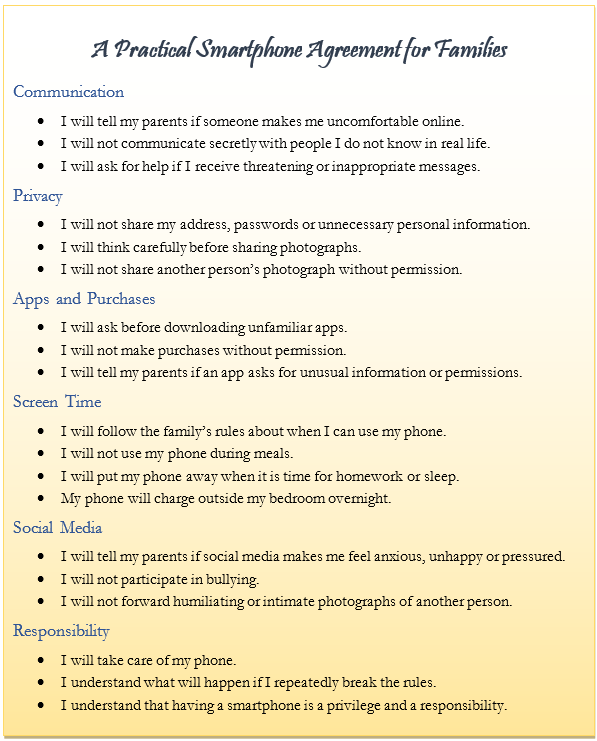
A sample of a Practical Smartphone Agreement for Families
Before giving a child a smartphone, parents may wish to agree on the following:
Final Thoughts
The decision to give a child a smartphone should not be based solely on age, peer pressure or convenience.
A smartphone represents a significant step toward independence.
The most important question is not: “What age do other children get phones?” It is: “Is my child ready to manage this responsibility?”
We should consider the child’s maturity, responsibility, ability to follow boundaries, emotional regulation, relationship with technology and understanding of online safety.
When the decision is made, the process should not end with handing over the phone.
It should be the beginning of an ongoing conversation.
Children need to know how to use technology, but they also need to know when to put it down, when to ask for help, and how to make responsible decisions when their parents are not watching.
A smartphone should therefore be introduced gradually, with clear expectations, appropriate supervision, ongoing education and increasing independence as the child demonstrates responsibility.
Most importantly, children should know that if something frightening, embarrassing, confusing or inappropriate happens online, they can always come to their parents.
REFERENCES
- World Health Organization. (2019). Guidelines on physical activity, sedentary behaviour and sleep for children under 5 years of age. Geneva: World Health Organization.
- American Academy of Pediatrics. (2024). Moreno, M. A. The Family Media Plan. Pediatrics, 154(6), e2024067417. DOI: 10.1542/peds.2024-067417.
- American Academy of Pediatrics.(2026). Digital Ecosystems, Children, and Adolescents:Policy Statement. Pediatrics,157(2), e2025075320, DOI10.1542/peds.2025-075320.
- American Psychological Association. (2023). Health Advisory on Social Media Use in Adolescence.
- Fassi, L., Thomas, K., Parry, D. A., Leyland-Craggs, A., Ford, T. J., & Orben, A. (2024). Social Media Use and Internalizing Symptoms in Clinical and Community Adolescent Samples: A Systematic Review and Meta-Analysis. JAMA Pediatrics, 178(8), 814–822. DOI: 10.1001/jamapediatrics.2024.2078.
- Koepp, M. J., Gunn, R. N., Lawrence, A. D., Cunningham, V. J., et al. (1998). Evidence for striatal dopamine release during a video game. Nature, 393(6682), 266–268.
- van den Heuvel, M., Ma, J., Borkhoff, C. M., Koroshegyi, C., Dai, D. W. H., Parkin, P. C., Maguire, J. L., Birken, C. S., & TARGet Kids! Collaboration. (2019). Mobile Media Device Use Is Associated With Expressive Language Delay in 18-Month-Old Children. Journal of Developmental & Behavioral Pediatrics, 40(2), 99–104.
- Walsh, J. J., Barnes, J. D., Cameron, J. D., Goldfield, G. S., Chaput, J.-P., Gunnell, K. E., Ledoux, A.-A., Zemek, R., & Tremblay, M. S. (2018). Associations between 24 hour movement behaviours and global cognition in US children: a cross-sectional observational study. The Lancet Child & Adolescent Health.
- Hutton, J. S., Dudley, J., Horowitz-Kraus, T., DeWitt, T., & Holland, S. K. (2020). Associations Between Screen-Based Media Use and Brain White Matter Integrity in Preschool-Aged Children. JAMA Pediatrics, 174(1), e193869. DOI: 10.1001/jamapediatrics.2019.3869.
- Carter, B., Rees, P., Hale, L., Bhattacharjee, D., & Paradkar, M. S. (2016). Association Between Portable Screen-Based Media Device Access or Use and Sleep Outcomes: A Systematic Review and Meta-analysis. JAMA Pediatrics, 170(12), 1202–1208.
- Bacil, E. D. A., da Silva, M. P., Martins, R. V., da Costa, C. G., & de Campos, W. (2024). Exposure to smartphones and tablets, physical activity and sleep in children from 5 to 10 years old: A systematic review and meta-analysis. American Journal of Health Promotion, 38(7), 1033–1047.
- Bal, M., Kara Aydemir, A. G., Tepetaş Cengiz, G. Ş., & Altındağ, A. (2024). Examining the relationship between language development, executive function, and screen time: A systematic review. PLOS ONE, 19(12), e0314540.
- Kross, E., Verduyn, P., Demiralp, E., Park, J., et al. (2013). Facebook use predicts declines in subjective well-being in young adults. PLOS ONE, 8(8), e69841.
- Common Sense Media. (2019). The Common Sense Census: Media Use by Tweens and Teens.
- Crofts, Thomans, Murrey Lee, McGovern Alyce, Milivojevic Sanja (2015). Sexting and Young People. Palgrave Macmillan, 263 pages, DOI 10.1057/9781137392817
- Ma, J., & Birken, C. (2017). Handheld screen time linked with speech delays in young children. Pediatric Academic Societies Meeting.
- To grow up healthy, children need to sit and play more: https://www.who.int/news/item/24-04-2019-to-grow-up-healthy-children-need-to-sit-less-and-play-more
- Teague S, Somoray K, Shatte A, et al. Digital Media Use and Child Health and Development: A Systematic Review and Meta-Analysis. JAMA Pediatrics. 2026;180(5):510–517. doi:10.1001/jamapediatrics.2026.0085.
- Raising Children Network. Parents & screen time: role-modelling. Raising Children Network (Australia). Accessed August 25, 2026. https://raisingchildren.net.au/grown-ups/family-life/media-technology/parent-technology-use
- OECD. (2026). Social media age restrictions for children: Why they are rising and what comes next. OECD. April 2026.
- UNICEF. (2026). Drawing a Line in Digital Spaces: Age-based restriction of social media. UNICEF Office of Research – Innocenti.